TBI-PCK / Axial space

Ultra-Thin Pancake Thru-Bore Slip Rings

Explore a flat annular contact arrangement when axial space is the limiting dimension and more radial room is available.

Typical design brief: Robot wrist or waist joints, compact radar tables and rotary medical mechanisms.

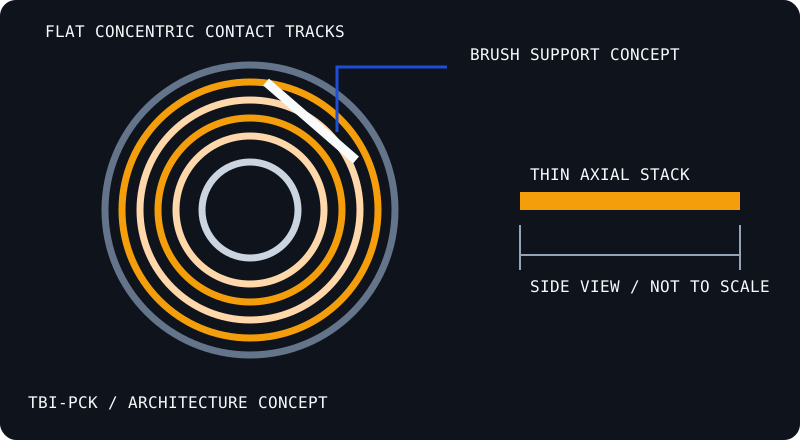
Concept section showing open center bore, annular contact paths, rotor and stator
Architecture concept · illustrative geometry, not a released product drawing.

IMPERIAL / METRIC SELECTION ENVELOPE

Define the bore and every circuit.

These are design request ranges, not an orderable stock specification. Exact dimensions, current derating and maximum speed require a released drawing.

Model / familyThru-bore ID (in / mm)OD × L (mm)Power circuitsSignal / data channelsMax speed (RPM)
TBI-PCK
4–36 requested concentric rings
Metric 20 mm / ≈0.787 inDrawing review requiredCircuit and temperature reviewSignal and shielding reviewDiameter and wear dependent
TBI-PCK
4–36 requested concentric rings
Metric 50 mm / ≈1.969 inDrawing review requiredCircuit and temperature reviewSignal and shielding reviewDiameter and wear dependent
TBI-PCK
4–36 requested concentric rings
Metric 100 mm / ≈3.937 inDrawing review requiredCircuit and temperature reviewSignal and shielding reviewDiameter and wear dependent
TBI-PCK
4–36 requested concentric rings
Metric 150 mm / ≈5.906 inDrawing review requiredCircuit and temperature reviewSignal and shielding reviewDiameter and wear dependent

Exact imperial conversions: 0.5″ = 12.7 mm · 1″ = 25.4 mm · 1.5″ = 38.1 mm · 2″ = 50.8 mm · 3″ = 76.2 mm · 4″ = 101.6 mm. Metric 50 / 70 / 100 mm bores remain separate choices.

APPLICATION REVIEW

What determines a workable TBI-PCK?

Saving axial space increases radial footprint and alignment demands. A requested 6–16 mm stack height is subject to brush support, wiring and enclosure design.

  • Available radial envelope and axial stack height
  • Flatness, runout and mounting datum scheme
  • Contamination, brush access and service conditions
Replacing an existing assembly? →
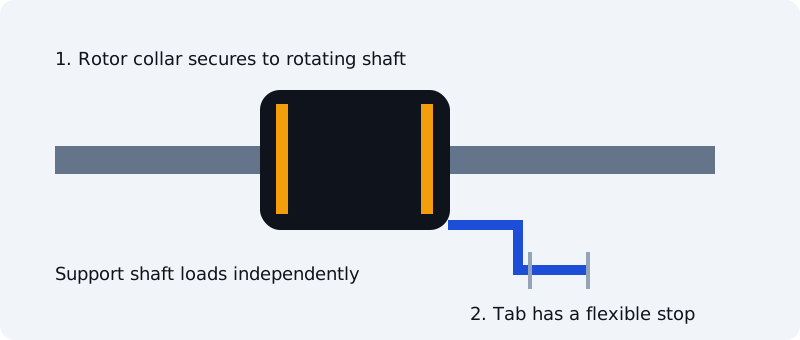
Concept mounting: rotor on independently supported shaft, stator tab restrained with compliance

Give the stator a flexible stop.

For a shaft-mounted design, secure the rotor as its drawing specifies and restrain the stator with an anti-rotation tab that accommodates misalignment. Avoid rigidly locking both sides. Mounting is model-specific; flange and capsule designs may differ.

Read the mounting checklist →

CONNECTORS / LEADS / ENCLOSURE

Send a complete TBI-PCK requirement.

Choose termination, wire length and mounting options below. Displayed accessory amounts are planning allowances; compatibility and final cost are confirmed with the quotation.

30-second configuration brief

Family ranges are reviewed together: selecting a larger bore does not establish high-speed or data-path compatibility. Enter an exact size in notes when choosing a nonstandard bore.

Assembly options

Illustrative accessory allowances, subject to compatibility and written quotation. Two options are preselected; clear either if unnecessary. Connector quantity, circuit count, wire gauge, custom harness work, sealing, shipping and any NRE are priced for the agreed configuration.

Connector and extended-length selections apply only when their corresponding assembly option is checked. Wire material, sealing scope and connector suitability require approval.

No payment is collected. No stock, dispatch date or performance is reserved by this request.

TBI-PCK engineering questions

Is a pancake ring always the smallest solution?

It can reduce axial length while increasing outside diameter. Compare the complete installed envelope, including brush holder and wiring.

Can it be used in a medical system?

Only after the responsible equipment team defines insulation, safety, traceability and qualification requirements. No medical approval is implied.

Compare adjacent slip ring architectures.

DEFINE THE ROTATING INTERFACE

Start with the bore.
Build the circuit schedule.

Send your shaft size, current, data interface and duty. Request a drawing and configuration-specific quotation.

Request engineering review ↗